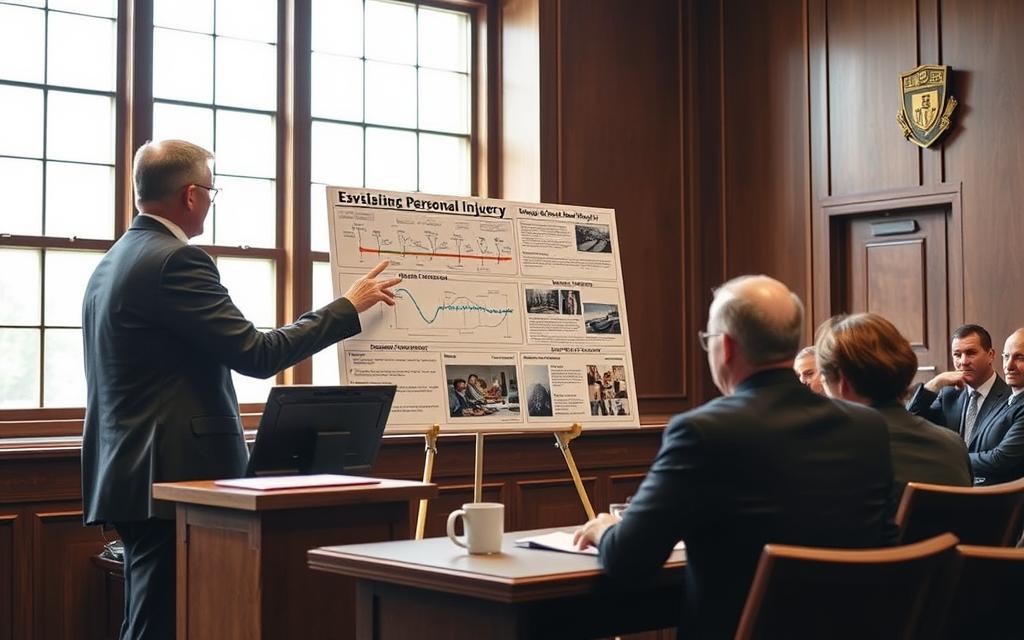
Ever wondered why some personal injury lawsuits win and others lose? The key is proving negligence. Knowing what negligence means can help you get fair compensation.
About 90% of personal injury cases win with strong evidence. To prove negligence, you need more than just your story. The National Highway Traffic Safety Administration says 94% of serious crashes are caused by people.
Going through a personal injury lawsuit can be tough. But with the right info, you can win. This guide will teach you how to prove negligence and get the compensation you need.
Key Takeaways
- Understand the four critical elements of proving negligence
- Collect robust evidence to support your personal injury claim
- Learn how to establish duty of care and breach of duty
- Recognize the importance of causation in negligence cases
- Discover strategies for building a strong legal argument
Understanding Negligence in Personal Injury Law
Negligence is key in personal injury law. It helps people who were hurt by someone else’s carelessness. Knowing about negligence is important for those who want justice.
Personal injury law sees negligence as a big deal. It’s when someone doesn’t act responsibly and hurts someone else. The idea is to keep people safe from harm.
Defining Legal Negligence
Negligence is when someone doesn’t act as they should. Legal negligence happens when someone doesn’t act like a careful person would in the same situation.
Categories of Negligence
- Ordinary Negligence: Unintentional failure to exercise reasonable care
- Gross Negligence: Extreme disregard for others’ safety
- Comparative Negligence: Shared responsibility for an incident
- Contributory Negligence: Partial fault that may impact compensation
Knowing about different types of negligence is key in lawsuits. About 90% of personal injury cases settle before going to court. This shows how important it is to have good evidence.
Most personal injury cases come from car accidents. This shows how common negligence is in our lives.
The Four Elements of Negligence
Understanding personal injury claims means knowing the key parts that show negligence. Proving fault in injury cases needs a detailed look at four main parts.
Winning personal injury cases depends on showing four important legal points. These parts are the core of proving who is at fault. They help show who is responsible.
- Duty of Care: Legal duty to avoid harm
- Breach of Duty: Not meeting the expected care standard
- Causation: Direct link between the breach and the injury
- Damages: The financial and emotional losses from the injury
Understanding Legal Requirements
Damages in personal injury claims show the financial and emotional costs of an event. The average cost of a hospital stay is about $10,000. Lost income can be around $1,500 per week.
Comprehensive Claim Evaluation
Each part must be carefully proven. The National Safety Council says the average cost of a workplace injury is $40,000. This shows how important detailed records and legal help are in negligence cases.
Victims have a good chance of winning—up to 90%—if they have clear proof of negligence. A smart plan is key to getting the right compensation.
Establishing Duty of Care
Understanding duty of care is key in negligence claims. It shows who must prevent harm to others. In personal injury cases, proving duty of care is the first step.
Duty of care comes from many relationships and situations. Each one has its own legal rules. These rules decide who might be liable:
- Doctor-patient relationships
- Employer-employee interactions
- Property owner responsibilities
- Professional service provider obligations
Key Examples of Duty of Care
Duty of care is shown in many ways. For example:
- Drivers must drive safely to avoid accidents
- Doctors must give standard care
- Employers must keep work places safe
- Property owners must fix hazards
Applying Duty of Care to Your Specific Case
To figure out duty of care, look at your case closely. Courts check the relationship between people and the care expected. Things like how close they are, if harm was seen coming, and risk matter a lot.
In Oregon, courts use a special rule for negligence. If someone is more than 50% to blame, they can’t get damages. This shows how important it is to show duty of care clearly in injury claims.
Demonstrating Breach of Duty
In the world of personal injury law, showing a breach of duty is key. A breach happens when someone doesn’t act as they should. This can make them legally responsible.

To understand legal steps, knowing what a breach is is important. It’s about comparing the defendant’s actions to what a “reasonable person” would do in the same situation.
What Constitutes a Breach?
A breach of duty is when someone doesn’t meet the expected standard of care. To prove negligence, you must show the defendant didn’t act like a careful person would.
- Failing to follow safety regulations
- Ignoring possible dangers
- Not being cautious enough
Examples of Breach in Common Cases
Here are examples of breaches in everyday life:
- Driving Violations: Running a red light or speeding
- Property Maintenance: Not fixing known dangers
- Professional Negligence: Doctors not correctly diagnosing
The contributory negligence defense is important here. It can affect if you can get damages. You must show the defendant’s actions caused your injury. This makes a clear link between the breach and the harm.
Proving Causation in Your Claim
Winning a personal injury lawsuit is all about proving causation. This key part shows how the defendant’s actions led to the plaintiff’s injuries. It’s a big part of showing the defendant was negligent.
Causation in personal injury cases can be tricky. There are two main types that lawyers look at closely:
- Actual Cause (Cause-in-Fact): The direct cause of the injury
- Proximate Cause (Legal Cause): The expected result of actions
The Link Between Breach and Injury
Experts play a big role in showing how a defendant’s mistake caused harm. They use the “but for” test to ask: Would the injury have happened if the defendant hadn’t acted wrongly?
Types of Causation: Actual vs. Proximate
Knowing the difference between actual and proximate cause is key. Actual cause is the direct cause of the injury. Proximate cause is whether the harm was likely to happen because of the defendant’s actions.
| Causation Type | Definition | Legal Significance |
|---|---|---|
| Actual Cause | Direct trigger of injury | Establishes immediate connection |
| Proximate Cause | Foreseeable result of actions | Determines legal responsibility |
Winning a personal injury case needs careful proof of causation. It turns complex legal issues into clear stories of who is to blame.
Collecting Evidence for Negligence Claims
Gathering strong evidence is key to winning negligence claims. Good evidence can help you get the compensation you need. It also helps in planning your personal injury trial.
The evidence you collect is the base of your legal case. It shows the defendant was negligent and how you were hurt.
Importance of Evidence in Your Claim
Evidence is very important in proving your negligence case. Without good evidence, your claim might not be strong enough. This could mean you don’t get the compensation you deserve.
Types of Evidence to Gather
- Photographic Evidence: Pictures of the accident scene, injuries, and property damage
- Medical Records: Detailed documentation of treatments and medical assessments
- Accident Reports: Official police or incident reports
- Witness Statements: Testimonies from individuals who observed the incident
- Expert Testimony: Professional assessments supporting your claim
It’s important to collect evidence fast. Memories can fade, and evidence can get lost over time. Start gathering evidence right away to keep your case strong.
Having a lawyer can help a lot. They can help you find and organize evidence. This makes your case stronger for your personal injury trial.
Witness Testimonies and Their Impact
Witness statements are very important in building a strong case. An injury lawsuit lawyer knows how key eyewitnesses are. Their stories can change the outcome of personal injury claims.
- They give a clear view of what happened
- They back up the victim’s story
- They prove things happened in a certain way
- They help figure out what happened when
How to Obtain Witness Statements
Getting witness statements needs a smart plan. It’s important to act fast because memories can change. Here’s how to do it well:
- Find people who saw the incident
- Get their contact info right away
- Ask them to write or record their story
- Check if they were close to the event
The Weight of Eyewitness Testimony
Courts look closely at who witnesses are when they hear about negligence. The following things make a witness’s story stronger:
| Credibility Factor | Impact on Case |
|---|---|
| Consistency of Account | High Reliability |
| Proximity to Incident | Direct Observation |
| Level of Detail | Enhanced Believability |
| Emotional Neutrality | Objective Perspective |
Expert tip: Many witnesses telling the same story can really help a case. It gives strong evidence that supports the victim and challenges defenses.
The Role of Expert Witnesses

Expert witnesses are key in proving negligence in personal injury cases. These experts give insights that can change the outcome of a case.
They help make complex information clear. This is important for proving a case. Experts come from different fields, each bringing their own view.
Critical Expert Witness Categories
- Medical Professionals: Check how bad an injury is and what treatment is needed
- Accident Reconstructionists: Look at how accidents happen and who is to blame
- Economic Experts: Figure out the money side of things, like future costs
- Engineering Specialists: Look at if products are safe and meet standards
Strategic Expert Witness Selection
Picking the right expert is important. They can:
- Show what care should have been given
- Show how an accident was caused
- Figure out how much money is owed
- Disagree with the other side
| Expert Type | Primary Function | Case Impact |
|---|---|---|
| Medical Expert | Injury Assessment | High Credibility |
| Accident Reconstructionist | Determine Fault | Technical Validation |
| Economic Expert | Calculate Damages | Financial Clarity |
Experts make hard information easy to understand. This helps make personal injury claims stronger.
Common Defenses Against Negligence Claims
Understanding negligence claim legal steps is key. Personal injury cases have complex legal strategies. These aim to reduce or block compensation.
When you sue for personal injury, you face many legal defenses. These can hurt your case. The main ones are contributory negligence and assumption of risk.
Understanding Contributory Negligence Defense
The contributory negligence defense can hurt your case a lot. In some places, it works like this:
- If you’re found 1% at fault for your injury
- You might not get any compensation
- The defendant must prove you were at fault
Comparative Negligence Laws in Action
Comparative negligence laws are more detailed. States use two main models:
- Pure Comparative Negligence: You can get some money, but less because of your fault
- Modified Comparative Negligence: You can’t get money if you’re more than 50% at fault
For example, if you sue for $100,000 and are 25% at fault, you might get $75,000. Knowing these laws helps protect your right to compensation.
The Importance of Legal Representation

Going through a negligence case is tough. An injury lawsuit lawyer helps a lot. They guide you through the legal maze.
Legal help is key for complex cases. Lawyers with experience know how to make a strong case.
Finding the Right Legal Support
Looking for a lawyer? Keep these points in mind:
- Look for someone who knows personal injury law well.
- Check if they have won cases like yours before.
- They should talk clearly and be easy to understand.
- Make sure their fees are clear and fair.
Critical Questions to Ask Your Legal Advisor
Choosing the right lawyer is very important. Make a list of questions for your first meeting:
- What experience do you have with cases like mine?
- How do you collect evidence?
- What strategies will you use for my case?
- What’s the timeline for my case, and what challenges might we face?
Studies show that having a good lawyer can really help. Over 40,000 people have gotten help from law firms. A skilled lawyer can help you get the compensation you deserve.
Filing a Negligence Claim: Step-by-Step
Going through a personal injury lawsuit needs careful planning. You must understand the legal steps well. Each step is important and needs the right documents.
Starting a negligence lawsuit is about knowing the legal steps. Victims must act fast to protect their rights. They need to find the right legal action.
Initial Consultation with an Attorney
Meeting a lawyer first is key. They will check if your case is strong. They look at:
- Detailed incident review
- Evidence assessment
- Potential compensation calculation
- Legal strategy development
Filing the Lawsuit and Discovery Process
Filing a negligence claim has important steps. Knowing these steps helps you understand your case better.
| Stage | Key Actions | Duration |
|---|---|---|
| Complaint Filing | Formal legal document submission | 1-2 months |
| Discovery | Evidence gathering and exchange | 3-6 months |
| Depositions | Witness and expert testimony collection | 2-4 months |
In New Mexico, personal injury claims have rules. Time is critical. Most cases have two years from when you got hurt.
To win a personal injury lawsuit, you need to be well-prepared. You need a good lawyer and all the evidence. Each step gets you closer to getting what you deserve.
Preparing for Trial or Settlement
When you’re in a personal injury case, knowing your options is key. Most cases, about 95%, settle before going to court. This means you’ll likely work on settling your case.
Insurance companies often choose to settle to save money. Your lawyer will help figure out how much you should get. The amount you get depends on your case’s details and how strong your evidence is.
Getting ready for trial means showing the defendant was likely at fault. Your lawyer will guide you through the legal steps. They help whether you settle or go to court.
If talks to settle fail, your lawyer will start getting ready for trial. This might include showing evidence, using experts, and picking a jury. While trials can lead to more money, they’re also more stressful and unpredictable than settling.